
Kia Picanto (JA): ISG (Idle Stop & Go) System / Clutch switch
Specifications
| Specifications |
|
Item
|
Specifications
|
| Working voltage | DC 12.5V |
| Operating force | Initial position : 0.25 ± 0.15 N (0.025 ± 0.015 kg, 0.056 ± 0.034 lb) |
| Full position : 0.8 ± 0.2 N (0.08 ± 0.02 kgf, 0.579 ± 0.014 lb-ft) | |
| Working temperature | -40°C to 80°C (-40°F to 176°F) |
Repair procedures
| Inspection |
| 1. | Remove the clutch & ignition lock switch. |
| 2. | Rotate the switch lever to the direction of the arrow to check the operating point (A).
|


| Removal |
| 1. | Turn ignition switch OFF and disconnect the negative (-) battery cable. |
| 2. | Remove the crash pad lower panel.
(Refer to Body - "Crash Pad Lower Panel")
|
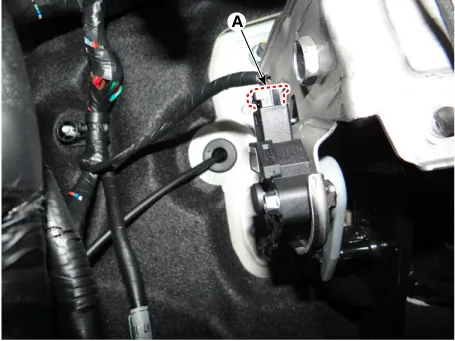
| 3. | Disconnect the cluch switch & ignition lock swtich connector (A).
|
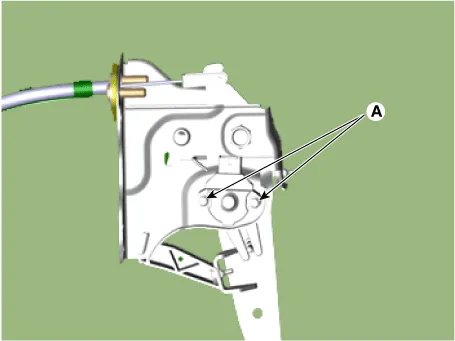
| 4. | Loosen the bolts (A) and then remove the ignition lock switch & clutch switch.
|
| Installation |
| 1. | Install in the reverse order of removal.
|


Description and operation Description The hood switch is included as the influencing factors in the calculation of the ISG function. If the hood is open, the engine must not be started or stopped by the ISG function for safety reasons.
Components and components location Components Location Fuel Tank & Filler-Neck Assembly 1. Fuel Tank 2. Fuel Pump 3 Fuel Filter 4.
Other information:
Kia Picanto (JA) 2017-2026 Service & Repair Manual: Front Fog Lamps
Repair procedures Removal 1.Disconnect the negative (-) battery terminal. 2.Remove the front bumper assembly. (Refer to Body - "Front Bumper Assembly") 3.Remove the front fog lamp assembly (A) after loosening the mounting screws.
Kia Picanto (JA) 2017-2026 Service & Repair Manual: Power Window Motor
Components and components location Components [Standard Window Motor] [Safety Window Motor] Repair procedures Inspection • When removing with a flat-tip screwdriver or remover, wrap protective tape around the tools to prevent damage to components.
Categories
- Manuals Home
- Kia Picanto Owners Manual
- Kia Picanto Service Manual
- Charging System
- Cooling System
- Cylinder Head
- New on site
- Most important about car
