
Kia Picanto (JA): Exhaust Emission Control System / CVVT (Continuous Variable Valve Timing) System
Description and operation
| Description |
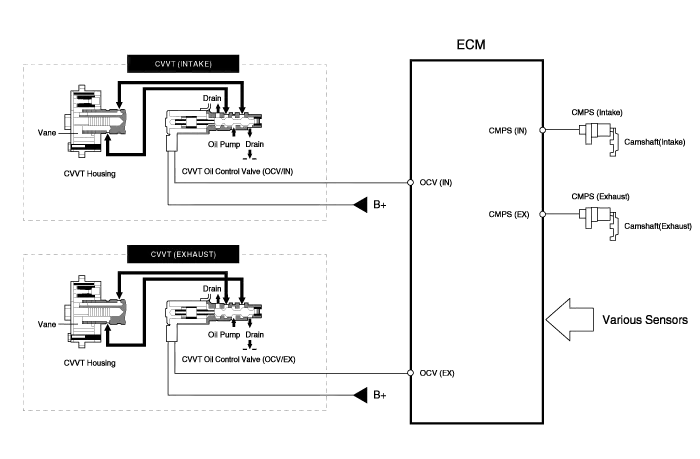
| – | the
CVVT Oil Control Valve (OCV) which supplies the engine oil to the cam
phaser or runs out the engine oil from the cam phaser in accordance with
the ECM PWM (Pulse With Modulation) control signal, |
| – | the CVVT Oil Temperature Sensor (OTS) which measures the engine oil temperature, |
| – | and the Cam Phaser which varies the cam phase by using the hydraulic force of the engine oil. |
| Operation Principle |
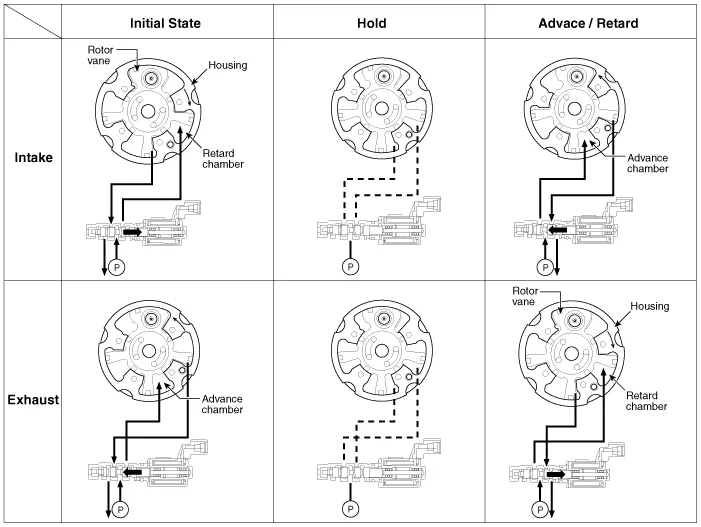
| [CVVT System Mode] |

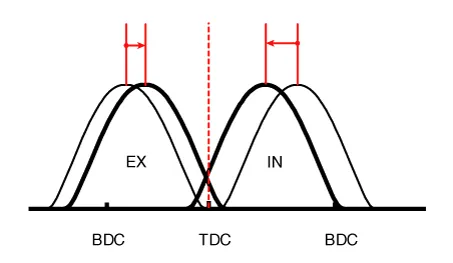
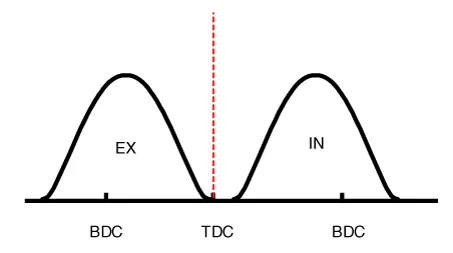
| (1) Low Speed / Low Load | (2) Partial Load |
|
|
| (3) Low Speed / High Load | (4) High Speed / High Load |
|
|
|
Driving
Condition |
Exhaust Valve
|
Intake Valve
| ||
|
Valve
Timing |
Effect
|
Valve
Timing |
Effect
| |
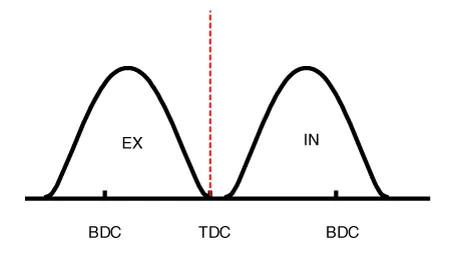
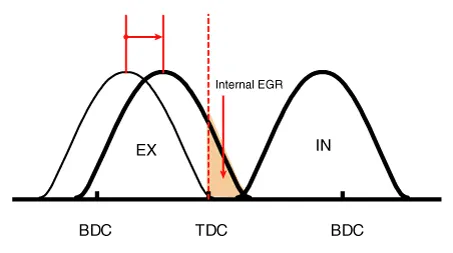
| (1) Low Speed /Low Load | Completely Advance | * Valve Under-lap * Improvement of combustion stability | Completely Retard | * Valve Under-lap * Improvement of combustion stability |
| (2) Part Load | Retard | * Increase of expansion work * Reduction of pumping loss * Reduction of HC | Retard | * Reduction of pumping loss |
| (3) Low Speed /High Load | Retard | * Increase of expansion work | Advance | * Prevention of intake back flow (Improvement of volumetric efficiency) |
| (4) High Speed /High Load | Advance | * Reduction of pumping loss | Retard | * Improvement of volumetric efficiency |
Description and operation Description The catalytic converter of the gasoline engine is a three way catalyst. It oxidizes carbon monoxide and hydrocarbons (HC), and separates oxygen from the oxides of nitrogen (NOx).
Specifications Specifications Fuel Delivery System Items Specification Fuel Tank Capacity 35 L (9.
Other information:
Kia Picanto (JA) 2017-2026 Service & Repair Manual: Emergency Call (eCall) Unit
Components and components location Component The eCall unit for AVN is equipped in AVN head unit. Repair procedures Removal Carry out the Test Mode in the following cases.– Replacing the eCall unit– Replacing the Bac
Kia Picanto (JA) 2017-2026 Service & Repair Manual: Rear Glass Defogger Printed Heater
Repair procedures Inspection • Wrap tin foil around the end of the voltmeter test lead to prevent damaging the heater line. Apply pressure on the tin foil with hand and move the tin foil along the grid line to check for open circuits.
Categories
- Manuals Home
- Kia Picanto Owners Manual
- Kia Picanto Service Manual
- Front Disc Brake
- Timing Chain
- Thermostat
- New on site
- Most important about car
